
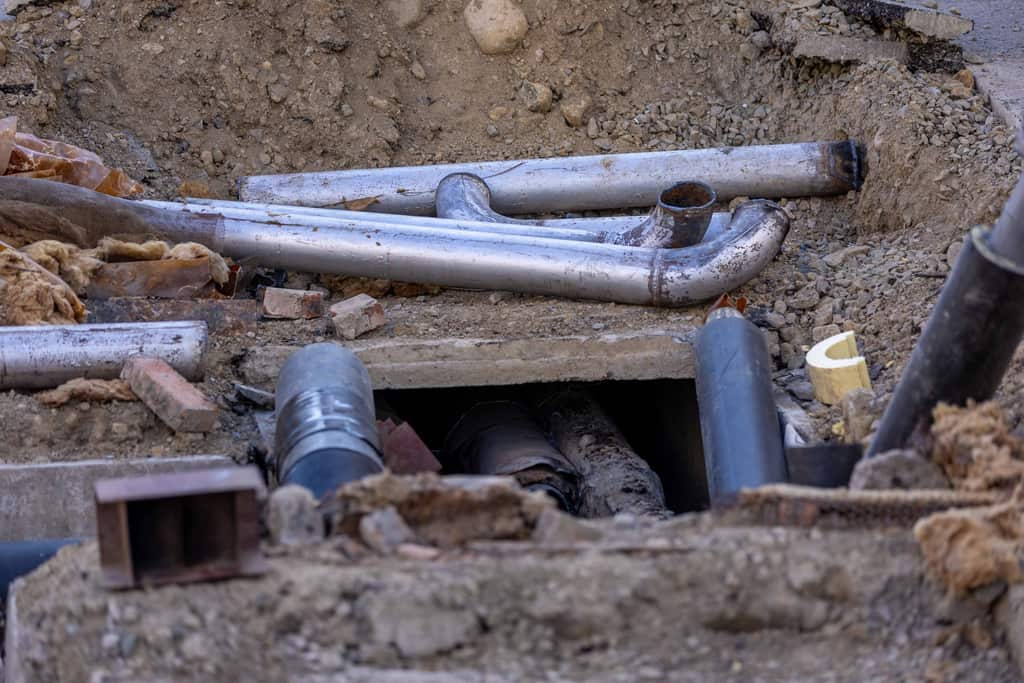
Photo by Sergei Starostin on Pexels.
Thames Water says sewers often run beneath back gardens, particularly in urban areas, and London’s terraces and semis are no exception. Plan a rear or side extension, a garden room with foundations, or underpinning, and there is a good chance the new work will sit over or close to that pipe. Build over it without the right permission and the consequences can include a refused completion certificate, a problem when you sell, and in the worst case a water company asking a court to have the building removed.
This guide explains when a London home needs a build over agreement, what the official rules say, what it costs, and the shortcuts that leave homeowners paying twice. It sits alongside our guides to vetting a building contractor and asbestos before building work.
Public sewer or private drain?
Who owns the pipe decides who you need to ask. Thames Water, which provides sewerage across most of London, defines a sewer as a pipe serving two or more properties, a lateral drain as a pipe serving one property but outside its boundary, and a drain as a pipe serving one property within its boundary. Many shared pipes became public in 2011. The government’s announcement of 1 October 2011 explains that private sewers shared between two or more properties, and lateral drains outside a property’s curtilage, transferred to the water and sewerage companies that day. Drainage serving only one property and within its curtilage stayed the owner’s responsibility.
So a pipe that a builder calls “just the house drain” may in fact be a public sewer, because it also carries your neighbours’ waste. That is the point at which permission is needed.
When you need a build over agreement
Thames Water’s build over agreements page says you are likely to need one if you are building within 3 metres of a public sewer, or within 1 metre of a public lateral drain. It says you should not start construction before getting an agreement, because it may need to change your design, and that planning permission does not give you permission to build over a sewer or drain. It also says that liability for any damage caused to sewers or drains during construction lies with you.
The national rule sits in the building regulations, and it is separate from the water company’s consent: building control approval is not a build over agreement, and a build over agreement is not building control approval. The guidance on requirement H4 in Approved Document H applies to building, extending or underpinning over or within 3 metres of the centreline of a drain, sewer or disposal main shown on the sewerage undertaker’s records (paragraph 0.1). Its guidance says, among other things, that:
- buildings should not be constructed over a manhole or inspection chamber on a sewer serving more than one property (paragraph 1.3);
- the length of drain or sewer under a building should not exceed 6 metres without the owner’s permission (paragraph 1.5);
- buildings should not be constructed over or within 3 metres of any drain or sewer more than 3 metres deep, or more than 225 mm in diameter, without the owner’s permission (paragraph 1.6);
- there should be a satisfactory route to divert the pipe if it ever needs replacing (paragraph 1.4).
Thames Water adds that without a build over agreement you may not be granted a building regulations completion certificate, which may cause problems when selling. It also says it has legal powers under the Water Industry Act 1991 to maintain, repair and renew public sewers, and that if building work limits this it could seek an injunction to remove the building and potentially recover damages.
Where you usually cannot build
- Over a manhole. Thames Water says internal manholes are not permitted, so a manhole in the footprint will need relocating through the build over application.
- Over strategic sewers. These are the most important pipes in the network, and Thames Water says it is unlikely to consent.
- Over rising mains. You cannot build over a pressurised sewer. The alternative is a diversion, which Thames Water describes as extensive work.
For small domestic jobs, Thames Water offers a minor sewer diversion where the sewer is 150 mm or less in internal diameter and the diversion is 20 metres or less. It requires CCTV surveys before and after, and a refundable cash deposit of £2,000.
What it costs and how long it takes
Thames Water’s application guidance lists these current charges, which it says are updated on 1 April each year:
- Class 1: £130, where the sewer’s internal diameter is 175 mm or less.
- Class 2: £490, for a larger sewer, with CCTV surveys before and after construction included.
- Class 3: £585, for the largest sewers, plus additional legal costs starting at £1,000.
Thames Water’s own pages give the upper limit for Class 2 as both 350 mm and 375 mm, so confirm the class for your pipe with Thames Water before you apply. It says its technical team will review an application within 21 days of submission and payment. Class 1 agreements are usually issued within 21 days of receiving everything required, Class 2 timings may vary if repairs are needed, and Class 3 can take more than three to six months.
You will need a location plan, an existing and proposed drainage layout showing the pipes, manholes and flow direction, and a section showing the foundation design and depth in relation to the sewer. Piled foundations need a piling method statement and raft foundations need structural calculations. Applicants entitled to disability benefit can get a £130 discount.
Find the pipe before you design

Photo by Ulrick Trappschuh on Pexels.
Thames Water says your builder or a drainage specialist can survey the sewers and drains within your boundary, that its asset maps can be viewed free by appointment at its Reading offices, and that online sewer maps can be bought from search companies. Checkatrade’s CCTV drain survey cost guide (updated October 2026) puts a basic CCTV survey at about £85 to £235, a full survey with a written report and drain map at about £200 to £350, and a large property at about £350 to £450, with £100 to £300 more if digging is needed. It notes that prices in London and the South East tend to be higher, and that the drain map is what you need if you are planning an extension.
A few hundred pounds at this stage is small next to the cost of redesigning foundations after the groundworks have started, or of a diversion you did not plan for.
Retrospective agreements are a gamble
If work has already been built over a public sewer, Thames Water accepts retrospective applications, but says they may not be approved if the pipework was not properly protected to its specifications. For every class, a CCTV or on-site survey is needed to check that the sewer was not damaged. Approved Document H also expects protection during construction: barriers to keep heavy traffic and stored materials off the line of the sewer (paragraph 1.7), and piling kept at least twice the pile diameter away from the outside of the sewer (paragraph 1.8).
Red flags from a builder
- “It’s only a private drain” without a survey or a look at the sewer records.
- Starting groundworks before the build over agreement or diversion is in place.
- Plans that put a manhole inside the new room.
- No foundation detail showing how the pipe is bridged or protected.
- Diggers, skips or stacked materials parked over the line of the sewer.
- A quote with no line for drainage surveys, manhole relocation or the application.
A short plan that saves time and money
Before final drawings, get the sewer records or a CCTV survey with a drain map, and mark every pipe and manhole within 3 metres of the new footprint. Ask your designer or engineer to show the foundations in section against the pipe, and decide early whether you need a build over agreement or a diversion. Make the agreement a condition of starting work in your building contract, and keep the signed agreement with your completion certificate for when you sell.
For the wider picture, see our guides to comparing building quotes like for like and paying a builder safely, the services page and our common questions. When you are ready, you can send a free enquiry. Sources were checked on 9 November 2026.
Quick answers
Do I need a build over agreement for an extension in London?
Thames Water says you are likely to need one if you build within 3 metres of a public sewer or within 1 metre of a public lateral drain. Get it before work starts; planning permission does not cover building over a sewer.
How much does a Thames Water build over agreement cost?
Thames Water lists £130 for Class 1 (sewers up to 175 mm), £490 for Class 2 and £585 for Class 3 plus legal costs from £1,000. It says charges are updated on 1 April each year, so check before you apply.
What if my builder has already built over the sewer?
You can apply retrospectively, but Thames Water says approval may be refused if the pipe was not properly protected, and a CCTV or on-site survey will be needed. Without an agreement, a completion certificate may be withheld.